EOL Full Form: Engine On Load
Reference: New/Revised Freight Marketing Circular No. 16 of 2023
Exam Relevance: Railway Departmental Examinations, ACM, DCM, Commercial & Operating Examinations
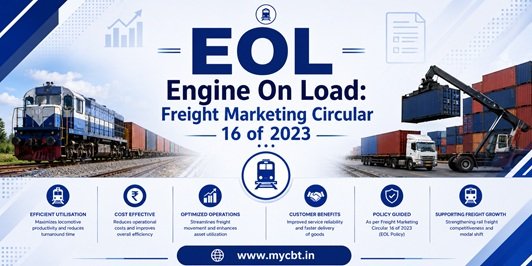
EOL – Engine On Load: Introduction
Engine On Load (EOL) is a system of railway freight terminal operations under which the same locomotive that places a freight rake at the terminal remains available during loading or unloading and works the rake immediately after the loading/unloading operation is completed.
The provisions relating to EOL were revised through Freight Marketing Circular No. 16 of 2023, which superseded the earlier instructions issued on EOL.
The EOL system is particularly relevant for modern freight terminals such as:
GCT – Gati-Shakti Cargo Terminals
PFT – Private Freight Terminals
Private Sidings
The objective is to ensure optimum utilization of rolling stock and prompt clearance of freight rakes from terminals.
Why was Freight Marketing Circular No. 16 of 2023 issued?
The revised EOL policy was introduced mainly to address changes and operational requirements in the freight terminal system.
Major reasons for the Circular
Launch of GCT – Gati-Shakti Cargo Terminals
Amendments in PFT and Private Siding policies
Addressing operational issues faced at terminals
Optimum utilization of railway rolling stock
Prompt clearance of freight trains/rakes from terminals
Exam Tip: If asked about the purpose of Freight Marketing Circular No. 16 of 2023, remember the keywords GCT + PFT/Private Siding + Operational Issues + Rolling Stock Utilization + Prompt Clearance.
What is EOL?
Engine On Load (EOL) is a system of operation in which the train locomotive remains available at the terminal during loading/unloading operations.
The locomotive waits on Railway's account during the permitted free time and is then used to work the rake immediately after loading/unloading is completed.
In simple words
EOL = Same locomotive stays with the rake during loading/unloading and takes the rake out after the operation.
Main features of EOL
The train locomotive remains available at the terminal.
The locomotive waits during the prescribed free time.
The waiting during free time is on Railway's account.
The same locomotive is available to work the rake after loading/unloading.
The system facilitates faster clearance of freight rakes.
It promotes better utilization of rolling stock.
Terminals Covered Under EOL
For the purpose of EOL operations, the relevant terminals include:
| Terminal | Full Form | EOL Relevance |
|---|---|---|
| GCT | Gati-Shakti Cargo Terminal | EOL |
| PFT | Private Freight Terminal | EOL |
| Private Siding | — | EOL |
| Other notified cargo terminals | — | Preferably EOL |
Important Rule
All new cargo terminals should preferably operate under the EOL system.
However, exemption may be granted where there are operational or geographical constraints.
Such exemption requires:
Consent of the Zonal Operating Department, and
Personal approval of the DRM.
Through Distance Basis and EOL
Terminals that are notified for charging on a Through Distance Basis can operate under the EOL system.
Exam Point
Through Distance Basis → EOL operation is permitted.
Who Provides the Loading/Unloading Facilities?
The Terminal Operator is responsible for providing the facilities required for loading and unloading operations.
Conversion of Non-EOL Terminal into EOL
A Non-EOL terminal can be converted into an EOL terminal subject to the prescribed conditions.
Conditions for Non-EOL → EOL
The terminal should satisfy the condition relating to Through Distance Basis.
An EOL Agreement must be signed with the concerned Division.
Quick Memory
Non-EOL → EOL = Through Distance Basis + EOL Agreement
Conversion of EOL into Non-EOL / Partial EOL
Conversion from EOL to Non-EOL or Partial EOL is permitted only when effective implementation of EOL is difficult because of operational or geographical constraints.
Approval Procedure
At Division Level
The Division should submit:
Detailed operational justification
Approval of the DRM
The proposal is then sent to the Zonal Headquarters.
At Zonal Headquarters
The proposal requires:
Joint approval of PCOM + PCCM
They will issue a reasoned speaking order.
Additional condition for Terminal Operator
The terminal operator must:
Clear all pending dues, and
Withdraw all pending arbitration/court cases against the Railways.
EOL Conversion – Exam Table
| Conversion | Major Requirement |
|---|---|
| Non-EOL → EOL | Through Distance Basis + EOL Agreement |
| EOL → Non-EOL | Operational/Geographical constraints + DRM approval + Joint PCOM/PCCM approval |
| EOL → Partial EOL | Operational/Geographical constraints + prescribed approval procedure |
Most Important Exam Point:
EOL → Non-EOL/Partial EOL requires DRM approval at Division level and joint approval of PCOM & PCCM at Zonal HQ.
What is Partial EOL?
Partial EOL is a situation where a terminal does not operate completely under one EOL arrangement.
It may occur in situations such as:
Example 1 – Old Plant and New Plant
A terminal may serve:
An old plant under Non-EOL, and
A new plant under EOL.
Example 2 – Different Commodities
A terminal may handle:
Coal unloading under EOL, while
Fly ash loading under Non-EOL.
Thus, EOL and Non-EOL operations can coexist at the same terminal in prescribed circumstances.
EOL Agreement – Signing Authority
The EOL agreement is signed between the Railway and the Terminal Operator.
| Party | Signing Authority |
|---|---|
| Railways | Sr.DCM |
| Terminal | Legal Representative |
Remember
Railway side → Sr.DCM
Terminal side → Legal Representative
Commercial Staff Cost Under EOL
The cost of commercial staff varies according to the type of terminal and whether it operates under EOL or Non-EOL/Partial EOL.
| Terminal Type | Category | Commercial Staff Cost |
|---|---|---|
| EOL | All categories | Nil |
| Non-EOL / Partial EOL | GCT | Nil |
| Non-EOL / Partial EOL | PFT / Private Siding | One staff |
Key Exam Point
The cost of one Commercial staff is borne by:
Non-EOL/Partial EOL PFT and Private Siding terminals.
For:
EOL terminals of all categories → Nil
Non-EOL/Partial EOL GCT → Nil
EHC – Engine Hire Charges
EHC = Engine Hire Charges
EHC is levied at the notified AIEHC – All India Engine Hour Cost.
Important Rule
EHC is charged for:
One locomotive for each rake
This applies even where:
Multiple locomotives are used, or
A double-headed locomotive is used,
depending upon the requirement of the load.
When is EHC Levied?
The applicability of EHC depends on:
Whether the loading/unloading operation is within or beyond free time, and
Whether the locomotive is present during the operation.
| Loading/Unloading Status | Locomotive Status | EHC |
|---|---|---|
| Within Free Time | Present | Nil |
| Within Free Time | Absent | Nil |
| Beyond Free Time | Absent | Nil |
| Beyond Free Time | Present | Yes |
Most Important Rule
EHC is applicable only when loading/unloading continues beyond free time and the locomotive remains present.
EHC is calculated:
From the end of Free Time up to completion of loading/unloading.
This applies irrespective of whether shunting operations have actually been performed or not.
EHC – Easy-to-Remember Formula
EHC applies when:
Beyond Free Time + Locomotive Present = EHC Applicable
EHC does NOT apply when:
Within Free Time = No EHC
or
Beyond Free Time + Locomotive Absent = No EHC
EOL and EHC – Important Distinction
A common examination trap is to assume that merely keeping a locomotive at a terminal automatically attracts EHC.
That is not correct.
The important conditions are:
Free Time exceeded + Locomotive present = EHC
Therefore:
| Situation | EHC |
|---|---|
| Free time not exceeded | Nil |
| Free time exceeded but locomotive absent | Nil |
| Free time exceeded and locomotive present | Applicable |
Siding Charges Under EOL
Siding Charges are Nil for:
EOL Terminals
Bulb Type Terminals
This is an important point for departmental examination MCQs.
What is a Bulb Type Terminal?
A Bulb Type Terminal is a terminal where freight is charged on the basis of through distance up to a specified loading or unloading point, rather than for the entire length of the terminal.
Simple Definition
Bulb Type Terminal = Through-distance charging up to the specified loading/unloading point.
Siding Charge
Siding Charges = Nil for Bulb Type Terminals.
EOL vs Non-EOL – Quick Comparison
| Feature | EOL | Non-EOL / Partial EOL |
|---|---|---|
| Locomotive | Remains available | May not remain available |
| Free-time waiting | Railway's account | As applicable |
| Immediate working of rake | Facilitated | Not necessarily |
| EHC within free time | Nil | — |
| EHC beyond free time with loco present | Applicable | — |
| Commercial staff cost – GCT | Nil | Nil |
| Commercial staff cost – PFT/Private Siding | Nil | One staff |
| Siding Charges | Nil | As applicable |
| Objective | Faster rake clearance & better rolling stock utilization | Conventional/partial operation |
EOL – Complete Process Flow
Step 1
The locomotive places the freight rake at the terminal.
↓
Step 2
The locomotive remains available during loading/unloading.
↓
Step 3
The prescribed free time is allowed.
↓
Step 4
If loading/unloading is completed within free time:
EHC = Nil
↓
Step 5
If loading/unloading continues beyond free time and the locomotive remains present:
EHC = Applicable
↓
Step 6
Loading/unloading is completed.
↓
Step 7
The same locomotive works the rake from the terminal.
Objective
Prompt clearance + optimum utilization of rolling stock
Important Abbreviations for Railway Exams
| Abbreviation | Full Form |
|---|---|
| EOL | Engine On Load |
| GCT | Gati-Shakti Cargo Terminal |
| PFT | Private Freight Terminal |
| EHC | Engine Hire Charges |
| AIEHC | All India Engine Hour Cost |
| DRM | Divisional Railway Manager |
| PCOM | Principal Chief Operations Manager |
| PCCM | Principal Chief Commercial Manager |
| Sr.DCM | Senior Divisional Commercial Manager |
Top 15 MCQ Points on EOL
1. What is the full form of EOL?
Answer: Engine On Load.
2. Which Freight Marketing Circular deals with the revised EOL system?
Answer: Freight Marketing Circular No. 16 of 2023.
3. What is the main purpose of EOL?
Answer: To keep the locomotive available during loading/unloading and facilitate prompt working/clearance of the rake.
4. Which terminals are covered under EOL?
Answer: GCTs, PFTs and Private Sidings, subject to the applicable provisions.
5. What is the preferred operating system for all new cargo terminals?
Answer: EOL.
6. Who provides loading/unloading facilities?
Answer: Terminal Operator.
7. Who signs the EOL agreement on behalf of Railways?
Answer: Sr.DCM.
8. Who signs the EOL agreement on behalf of the terminal?
Answer: Legal Representative.
9. Who jointly approves conversion of EOL into Non-EOL/Partial EOL at Zonal HQ?
Answer: PCOM and PCCM.
10. What type of order is issued by PCOM & PCCM?
Answer: A reasoned speaking order.
11. Who gives approval at the Division level for EOL → Non-EOL/Partial EOL?
Answer: DRM.
12. When is EHC applicable?
Answer: When loading/unloading continues beyond free time and the locomotive remains present.
13. For how many locomotives is EHC levied per rake?
Answer: One locomotive.
14. What is the commercial staff cost for EOL terminals?
Answer: Nil for all categories.
15. What are the siding charges for EOL and Bulb Type Terminals?
Answer: Nil.
Super Important One-Liners for CBT/ACM Exams
EOL = Engine On Load
Circular governing revised EOL = Freight Marketing Circular No. 16 of 2023
New cargo terminals = Preferably EOL
Non-EOL → EOL = Through Distance Basis + EOL Agreement
EOL → Non-EOL/Partial EOL = DRM approval + PCOM & PCCM joint approval
PCOM & PCCM = Reasoned Speaking Order
EOL Agreement – Railway = Sr.DCM
EOL Agreement – Terminal = Legal Representative
EHC = Engine Hire Charges
AIEHC = All India Engine Hour Cost
EHC beyond free time + locomotive present = Applicable
EHC beyond free time + locomotive absent = Nil
EHC within free time = Nil
Commercial staff cost – EOL = Nil
Commercial staff cost – Non-EOL/Partial EOL GCT = Nil
Commercial staff cost – Non-EOL/Partial EOL PFT/Private Siding = One staff
Siding Charges – EOL = Nil
Siding Charges – Bulb Type Terminal = Nil
Memory Trick for EOL
“EOL = Engine Waits, Operation Leaves”
Think of EOL as:
Engine stays → Free time → Loading/Unloading → Engine works → Rake clears
For EHC, remember:
“Beyond + Present = Pay”
Beyond Free Time + Locomotive Present = EHC
Quick Revision Table
| Topic | Answer |
|---|---|
| EOL | Engine On Load |
| Circular | Freight Marketing Circular 16 of 2023 |
| GCT | Gati-Shakti Cargo Terminal |
| PFT | Private Freight Terminal |
| EHC | Engine Hire Charges |
| AIEHC | All India Engine Hour Cost |
| New cargo terminals | Preferably EOL |
| Non-EOL → EOL | Through Distance Basis + Agreement |
| EOL → Non-EOL/Partial | DRM + PCOM/PCCM approval |
| Zonal approval | Joint PCOM & PCCM |
| Type of order | Reasoned speaking order |
| Railway agreement authority | Sr.DCM |
| Terminal agreement authority | Legal Representative |
| EOL Commercial staff cost | Nil |
| Non-EOL/Partial GCT staff cost | Nil |
| Non-EOL/Partial PFT/Private Siding | One staff |
| EHC within free time | Nil |
| EHC beyond free time + loco absent | Nil |
| EHC beyond free time + loco present | Applicable |
| EHC basis | Notified AIEHC |
| EHC per rake | One locomotive |
| EHC period | End of free time to completion |
| Shunting performed or not | Does not affect EHC applicability |
| EOL Siding Charges | Nil |
| Bulb Type Terminal Siding Charges | Nil |
Final Takeaway for Railway Departmental Exams
The Engine On Load (EOL) system is designed to improve the efficiency of freight terminal operations by keeping the locomotive available during loading/unloading and enabling the rake to be worked promptly after completion of terminal operations.
For examination purposes, the most important areas are:
Circular 16 of 2023 → EOL definition → GCT/PFT/Private Siding → New terminals → Conversion procedure → Partial EOL → Agreement authorities → Commercial staff cost → EHC → AIEHC → Free Time → Bulb Type Terminal → Siding Charges.
⭐ Most Expected MCQ Facts
EOL = Engine On Load
EHC = Engine Hire Charges
AIEHC = All India Engine Hour Cost
New Cargo Terminals = Preferably EOL
EHC = Beyond Free Time + Locomotive Present
EOL Agreement = Sr.DCM + Legal Representative
EOL → Non-EOL/Partial EOL = DRM + PCOM/PCCM
Siding Charges for EOL & Bulb Type Terminals = Nil